
Safety Eyewear
Are Sunglasses Bad for Your Eyes?
Sep
Are sunglasses bad for your eyes? Usually, no. In fact, quality sunglasses can provide important protection from ultraviolet (UV) radiation and reduce glare in bright conditions.
But there’s a catch, especially at work.
Your favorite pair of sunglasses may be perfectly fine for a Saturday afternoon drive or a day at the beach. Put them on a construction site, manufacturing floor, warehouse, or other hazardous workplace, however, and you’re asking them to do a job they weren’t necessarily designed to do.
Sunglasses protect against sunlight. Workplace eye protection protects against workplace hazards. Those aren’t the same thing.
Sunglasses Aren’t Safety Glasses
Let’s clear up the biggest misconception first.
A pair of dark lenses doesn’t automatically make something protective eyewear.
Ordinary sunglasses are generally designed to reduce brightness, glare, and UV exposure. They’re not necessarily engineered or tested to provide the impact protection required for many workplace environments.
That’s a pretty important distinction when the hazard isn’t sunlight.
Flying metal fragments. Wood chips. Dust. Grinding debris. Chemical splashes.
Your sunglasses weren’t hired for that job.
Dark lenses don’t stop flying debris just because they’re dark.
Workplace safety eyewear is specifically designed to address hazards employees may encounter on the job. Depending on the application, that can include impact-resistant lenses, side protection, specialized coatings, and other protective features.
So, Are Sunglasses Bad for Your Eyes?
The sunglasses themselves aren’t necessarily the problem.
The problem is wearing the wrong eyewear for the environment.
Quality sunglasses that provide appropriate UV protection can be beneficial when you’re outdoors. But wearing ordinary sunglasses in place of required workplace eye protection can leave employees vulnerable to hazards that have nothing to do with sunlight.
And there’s another issue: some extremely cheap sunglasses may provide poor optical quality or inadequate UV protection. Dark lenses without proper UV protection can be particularly concerning because they reduce visible light while still allowing harmful UV radiation through.
The solution isn’t to stop wearing sunglasses.
It’s to wear the right eyewear for the right job.
Workplace Eye Protection Has a Bigger Job to Do
Workplace eye protection needs to address the hazards employees actually face—not just make the sun less annoying.
For outdoor workers, that may mean protection from both UV exposure and physical hazards. For employees working around machinery, grinding operations, cutting equipment, or flying particles, impact protection may be critical. Other environments may create splash or dust hazards requiring different forms of protection.
That’s why employers should start with a hazard assessment, not a shopping list.
Identify the hazard first.
Then select the appropriate protection.
It’s a simple concept, but skipping that first step can create a serious gap in your safety program.
What About Safety Sunglasses?
Now we’re talking.
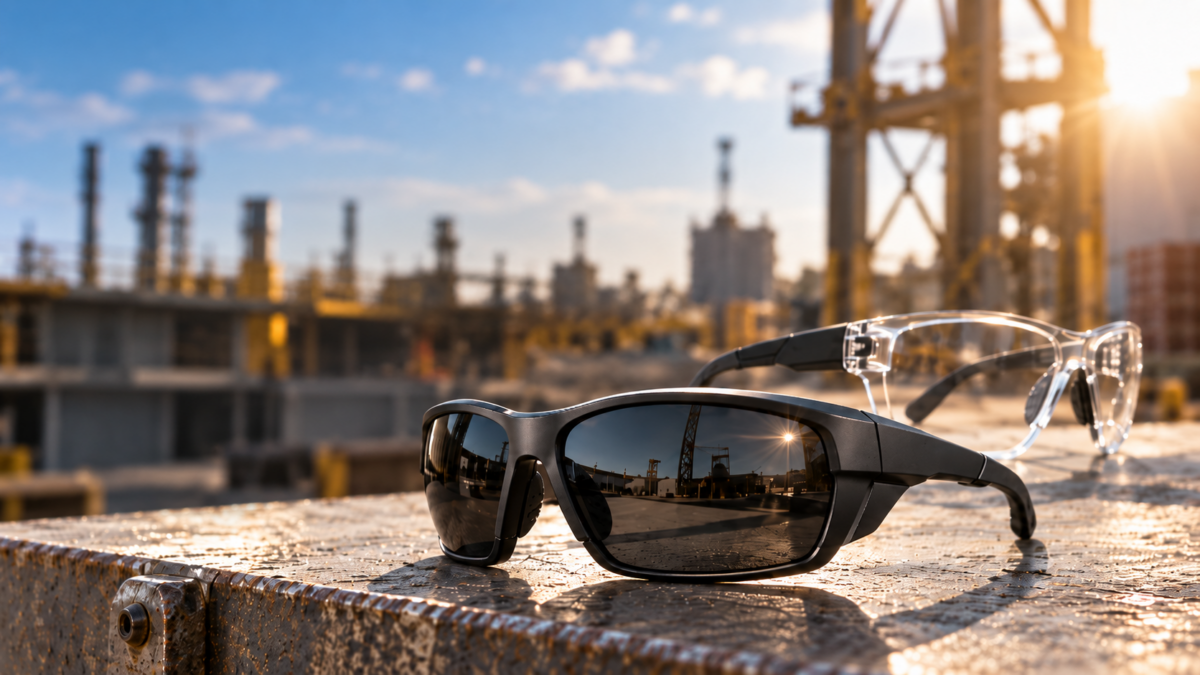
Safety sunglasses can provide the best of both worlds for certain outdoor workplace environments: protection from the sun combined with workplace-rated protective features.
When appropriate for the hazards involved, ANSI Z87 safety glasses can provide impact protection while tinted lenses can help reduce glare and brightness.
That’s a much better solution than telling employees to grab whatever pair of sunglasses they happen to have in their vehicle.
Because “I had sunglasses on” isn’t much of a defense after an eye injury.
Prescription Wearers also Need Protection
There’s another group that deserves special attention: employees who need corrective lenses.
Trying to wear ordinary sunglasses over prescription glasses isn’t exactly an ideal workplace solution. The combination can be uncomfortable, awkward, and potentially interfere with proper fit.
Prescription safety eyewear addresses the problem at its source by combining vision correction with protective features appropriate for the workplace.
That means employees don’t have to choose between seeing clearly and protecting their eyes.
And they shouldn’t have to.
Clear vision is important. Eye protection is important. You need both.
Don’t Let a Pair of Sunglasses Fool You
Sunglasses have their place.
They can reduce glare. They can provide UV protection. They can make a bright day considerably more comfortable.
But workplace eye protection has a different mission.
If employees are exposed to impact, flying particles, dust, chemical splash hazards, or other risks, ordinary sunglasses may not provide the protection required for those conditions. The fact that eyewear looks protective doesn’t mean it meets the appropriate safety requirements.
If the job can hurt your eyes, dress your eyes for the job.
At Z87 OPTICS, we provide prescription safety eyewear designed to help workers maintain clear vision while getting the protection they need on the job.
Because sunglasses are great for the beach.
Your workplace demands better.
